Why Jowls Form: Skin Laxity, Collagen, and Subcutaneous Fat
Sagging jowls rarely come from one cause. They form when several layers of the face change at once, and knowing which layer is driving yours changes what treatment makes sense.
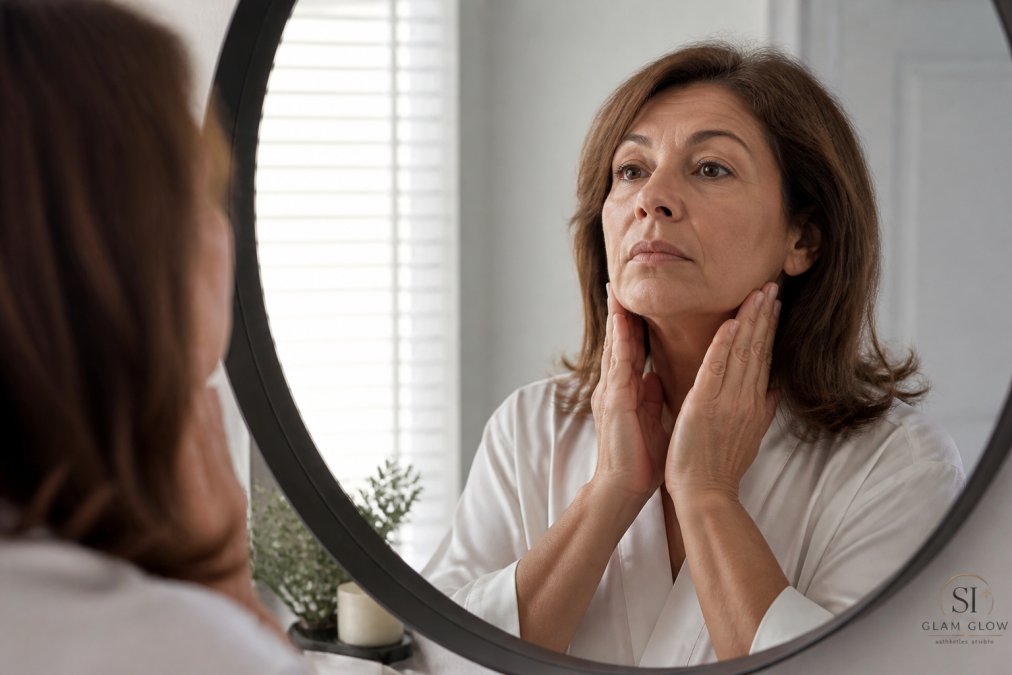
Woman in her fifties checking her jawline before a collagen facial treatment in a mirror.
What Actually Changes in the Jawline as You Age
Think of the jawline as a tent. The skin is the canvas, collagen and elastin are the fibers, fat is the padding, and bone is the frame. Aging loosens the fibers, shifts the padding, and gradually resorbs the frame.
What a Collagen Facial Can and Cannot Do for Saggy Jowls
The truthful response is that a collagen facial can lead to improved skin firmness, hydration, and tone, but it won’t remove already existing jowls. In the case of mild laxity that is mostly superficial, you might observe a more refreshed and somewhat lifted appearance. However, if the laxity is structural, a facial by itself won’t be able to reverse it.
What facials do well:
Support collagen synthesis over time through controlled stimulation
Improve skin hydration and epidermal health
Smooth skin texture and soften fine lines
Boost circulation for a healthier glow
What they do not do:
Remove or reposition fat
Tighten loose muscle
Replace lost bone structure
Match the lifting effect of surgery
Where Marketing Hype Outpaces Realistic Results
The term “collagen” is very effective at attracting customers. While a cream or facial can help boost the collagen that your skin produces on its own, it won’t add new collagen to your face in the way that spackle does. The results come slowly and build up over time, and can only properly be assessed over a period of weeks, not minutes.
Watch Out
If any treatment claims it can ‘melt’ your jowls or substitute for a facelift, then you should leave it alone since such a claim will lead to disappointment and, in certain cases, result in you spending money on sessions that were never going to work.
Microcurrent for Jowls: The Closest Thing to a Non-Surgical Lift
Microcurrent treatment for the jowls involves the use of very low electrical currents to stimulate the facial muscles and is usually referred to as a workout for the face, a comparison which is reasonable.
The ULTIMATE Guide to Treating Sagging Jowls | Doctorly Explains
Doctorly
Pro Tip
It is best to schedule microcurrent treatments right up to the event rather than doing so several months in advance. Since the effects appear quickly but also disappear just as quickly, getting the treatments close to the date will give you the most benefit from each session.
Best Professional Facials for Aging Skin and Jawline Firmness
The most effective professional facials for skin that is aging are those which are tailored to your particular concern rather than simply having the most fashionable name on the menu; firmness, texture, and hydration all require different methods.
How These Treatments Compare on Cost, Comfort, and Downtime
The prices will differ depending on the studio, the treatment, and the number of sessions you agree to have, so it’s a good idea to ask for the current rates before booking. At this stage you can compare the level of comfort and the amount of downtime, since these factors are just as important when making your decision.
Dermal Fillers, Injectables, and When to See a Dermatologist
The effects of dermal fillers and injectables differ from those of facials in that they add volume, relax certain muscles, or provide support. With regard to the jowls, they can help to reduce the appearance of heaviness, but they do not tighten the skin.
See a dermatologist or qualified medical provider if you notice:
Rapid or one-sided changes in your face
Significant laxity you want to address structurally
Skin conditions that need diagnosis
Interest in injectables, fillers, or surgical options
Key Takeaway
Facials help to improve the quality of the skin while medical treatments focus on the skin’s structure. If you know which type of treatment is suitable for your particular concern, you will avoid wasting time, money, and experiencing disappointment.
How Long Do Facial Results Last, and What Maintenance Looks Like
The question that most people ask following the first session is the one that is usually omitted in articles. Here is a practical roadmap.
How Long Results Actually Last
Hydration and glow facials (Glo2Facial, HydroDerm): days to about two weeks. Best timed before events.
Microcurrent: a visible lift that lasts days to a few weeks. It does not accumulate the way collagen-stimulating treatments do.
Microchanneling: results build over a series of sessions and hold longer with consistent upkeep. Most people notice changes over weeks, not days.
Buccal massage: same-day contour and reduced puffiness, fading within days.
Dermaplaning: smoother texture and better product absorption for roughly two to four weeks.
A Maintenance Roadmap by Goal
Goal
Typical Rhythm
Notes
Event-ready glow
1-2 weeks before the date
One session is often enough
Ongoing hydration and tone
Every 4-6 weeks
Fits a regular skincare rhythm
Visible firmness support
A series, then periodic upkeep
Results build gradually
Tension and puffiness relief
Every 2-4 weeks
Pairs well with at-home massage
Texture and product absorption
Every 4-6 weeks
Avoid over-exfoliating between visits
What Happens If You Stop
Nothing dramatic. Results fade gradually rather than reversing overnight. Skin returns to its baseline pattern, which is why consistency matters more than intensity. One dramatic session will not outlast a steady schedule, and skipping months between visits means starting closer to zero each time.
The At-Home Half of the Equation
Professional treatments only do part of the work. The rest happens between visits:
Sunscreen daily. UV exposure breaks down collagen, which works against everything you are paying for.
A retinoid two to three nights a week. Vitamin A supports collagen production and cell turnover over time. Build up slowly.
Peptides and moisturizer on off nights. These support the skin barrier so it recovers well between treatments.
Hydration inside and out. Water intake and a good moisturizer both support epidermal health.
Sleep and stress management. Both affect skin recovery more than most people realize.
Watch OutThe most common mistake is treating a series as a one-time fix. If you book a collagen-stimulating series and then stop all at-home support, results fade faster and the next series starts from a lower baseline.
When to Reassess
The fact that you’ve finished a reasonable course of treatment and have not noticed any change in firmness or texture is useful. It could indicate that the treatment is not tackling the main issue you have, or that your laxity is of a structural nature rather than just surface-level. In such a case, having a discussion about alternative possibilities, such as being referred to a dermatologist, is the honest thing to do.
Key TakeawayMaintenance is not a sales tactic. It is how gradual treatments hold their ground. A realistic schedule you can actually keep beats an aggressive one you abandon after two months.
At-Home Support: Retinoids, Peptides, and Collagen Production
Home care doesn’t take the place of professional treatments, but it helps to preserve your results. Retinoids, which are a type of vitamin A, contribute to collagen production and promote cell turnover over a period of time. Peptides assist in maintaining skin firmness and the barrier. Like both of these, they act slowly and require patience.
A simple approach:
Introduce a retinoid two to three nights a week, then build up
Use peptides and a good moisturizer on off nights
Wear sunscreen daily, since UV exposure breaks down collagen
Keep skin hydrated to support epidermal health
Watch OutStarting a strong retinoid every night, right away, is the most common mistake I see. It often causes irritation that people blame on the product, when the real issue was pacing.
Conclusion
Sagging jowls are a layered problem, and a collagen facial is one useful layer, not the whole answer. If your laxity is mild, a well-matched treatment can improve firmness, texture, and glow. If it is structural, the honest move is a medical evaluation.
Frequently Asked Questions
Can a collagen facial actually tighten sagging jowls?
A collagen facial has the potential to improve the hydration, texture, and firmness of the skin, which might cause the jawline to appear a bit smoother. However, it is not capable of restoring deep structural support or getting rid of loose skin; sagging jowls generally result from shifts in the subcutaneous fat and from connective tissue that has stretched and lies below the surface. You should view a collagen facial as one that enhances the quality of the skin rather than as a way of countering the effects of gravity. While many customers report looking fresher after undergoing a number of treatments, the results can differ and it is important to have realistic expectations rather than be influenced by marketing claims.
What is the best facial treatment for sagging jowls?
There isn’t one single best solution since jowls can have a variety of causes. Microcurrent treatment can give a more lifted appearance by temporarily tightening the facial muscles, whereas microchanneling and Glo2Facial help to promote collagen production gradually. Buccal massage is useful for relieving the tension which can cause the lower face to be pulled downwards. In the case of more serious laxity, dermal fillers or a procedure that has been assessed by a dermatologist might be more effective. A tailored plan that is developed following a face-to-face skin evaluation is generally more effective than selecting a treatment based on current trends.
How long do facial results last?
The effect depends on the type of treatment. With microcurrent treatments the results can last from a few days to a few weeks, which is why it’s necessary to have regular sessions in order to keep them. Those facials that hydrate such as HydroDerm or oxygen treatments produce at once a swelling effect that disappears within a few days. Treatments that stimulate collagen, for example microchanneling, produce results slowly, with the improvements showing up over a period of weeks and lasting longer if maintenance treatments are carried out. Generally speaking, it is consistency that is more important than any one visit, since the results differ from person to person.
Are collagen-boosting facials safe for sensitive or redness-prone skin?
A great many do, particularly those that are mild—for example, Glo2Facial, oxygen facials, and hydrating treatments designed for reactive skin. More intensive methods, such as those based on retinoids or deeper exfoliation, should be introduced gradually. It’s important to let your esthetician know if you have rosacea, have recently had any treatments, or are currently experiencing breakouts. carrying out a patch test or making an adjusted plan can help lower the risk of irritation. Having professional advice helps you to prevent the redness and peeling that some people are concerned about.
Do collagen supplements or creams really help jowls?
Most topical collagen remains on the surface of the skin and does not penetrate deeply enough to restore its structure, whereupon it mainly helps with hydration and the health of the epidermis. Although collagen peptides taken by mouth might help to support skin elasticity from within, the effects appear only gradually and are systemic. In neither case do these methods take the place of professional treatments or correct noticeable laxity. They work most effectively as complementary habits when combined with facials, regular sun protection, and a skincare routine that includes retinoids or peptides.