
Before you book anything, it helps to know what peach fuzz actually is, why it starts showing up in photographs when it never used to, and which method of removal genuinely suits fine facial hair rather than coarse hair.
This page answers those questions honestly, including where the popular options fall short. It is a guide, not a sales pitch — if you already know you want the treatment, the booking page has the pricing and the calendar.
Peach fuzz is not a skin problem, a hygiene issue, or a sign that something has gone wrong. It is vellus hair — the soft, short, fine hair that covers most of the human body, including the face. It exists to help regulate temperature and to make the skin more sensitive to touch. Almost everybody has it.
What varies is how visible it is. Vellus hair is usually pale or entirely unpigmented, so whether you notice it has less to do with how much you have and more to do with how light happens to be falling on your face at the time.
That distinction matters more than it sounds, because it determines which removal methods can work at all. A method that finds hair by its color cannot find a hair that has none. That is the single most useful thing to understand before choosing how to deal with it.
Vellus Hair
commonly called “peach fuzz”
Nearly every piece of confusing advice about facial hair comes from treating these two as the same thing. They are not, and they do not respond to the same removal methods.
This is peach fuzz
This is not peach fuzz
If the hair you are concerned about is dark, coarse, and firm to the touch, it is terminal hair rather than peach fuzz, and a different conversation applies. If you are unsure which you have, that is a perfectly reasonable thing to ask a licensed esthetician to look at in person.
A very common experience is feeling that peach fuzz has appeared out of nowhere. Usually it has not. What has changed is one of the following.
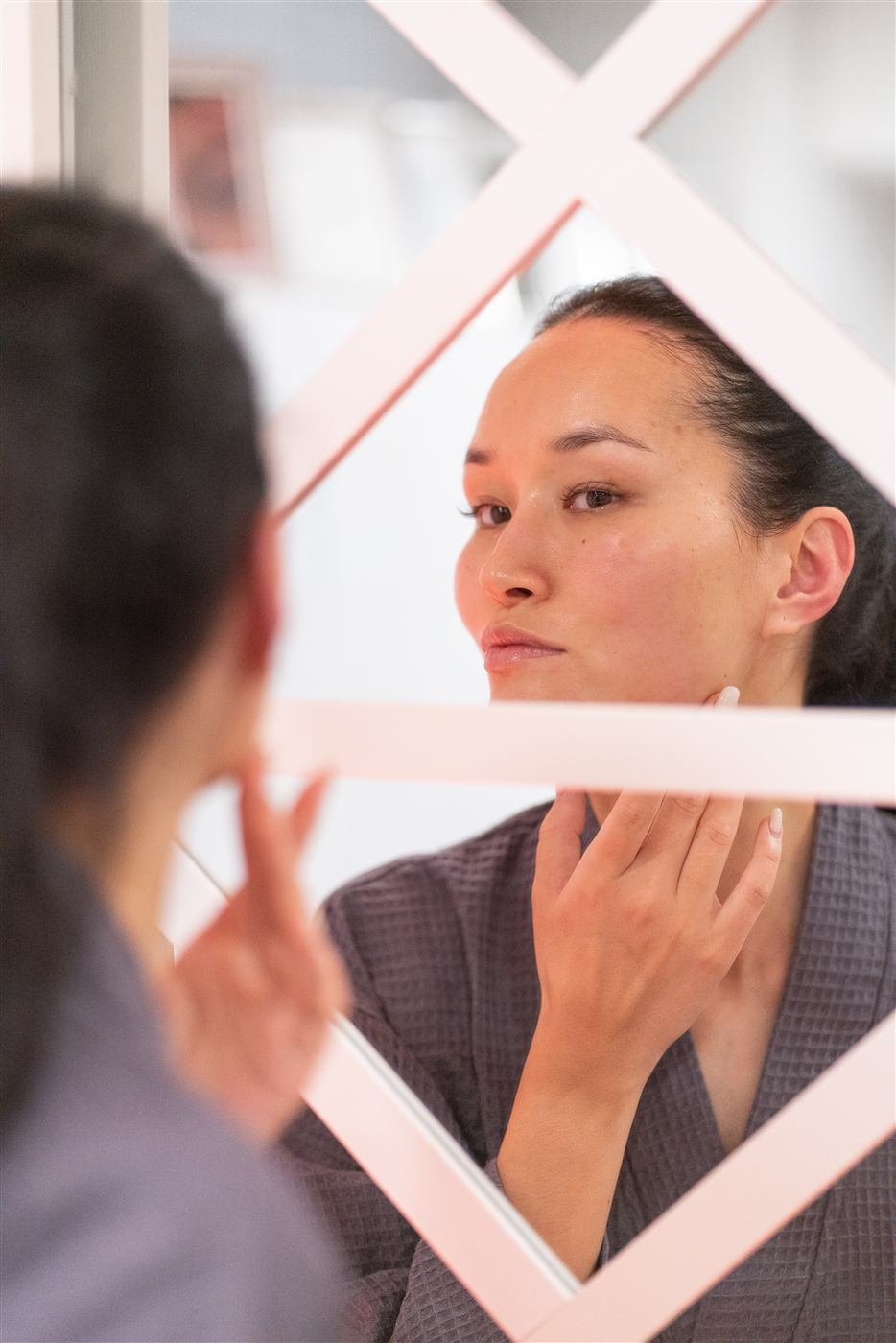
Vellus hair is only visible when light hits it from the side and scatters. Overhead office lighting, changing-room mirrors, and low afternoon sun all do this. The same face in flat, front-on light shows almost nothing.
Phone cameras use a wide lens held close to the face, often with a bright screen or flash directly in front of it. That combination exaggerates surface texture in a way that mirrors simply do not.
Matte, long-wear, and heavily pigmented foundations cling to fine hair far more than sheer or dewy formulas. Switching product can make existing peach fuzz obvious overnight without a single hair having changed.
A build-up of dead surface cells makes skin less reflective, which increases the contrast between the skin and the hair sitting on it. The fuzz has not grown; it has simply become easier to pick out.
Hormonal changes across life stages, and some medical conditions and medications, genuinely can alter facial hair. If your hair is becoming noticeably darker or coarser rather than simply more visible, that is worth raising with a doctor rather than an esthetician.
Not a trivial point. Once you have noticed peach fuzz, you tend to check for it, in the specific lighting where it shows. Most people have carried the same fuzz unremarkably for years.
There is no single best method of facial hair removal. There is the one that suits your hair type, your skin, and how much recovery time you are willing to accept. Here is the comparison, including the parts that do not favor us.
For fine, pale peach fuzz specifically, dermaplaning is the method we recommend, and it is the only one of the four that exfoliates at the same time. For coarse, dark terminal hair, one of the others will serve you better. SI Glam Glow offers dermaplaning only — we do not offer waxing, threading, or laser hair removal, so there is nothing for us to upsell you into here.
This is the question we are asked most often by people who have already spent money trying to solve it. The explanation is genuinely simple once you know what a laser is aiming at.
Laser hair removal works by emitting light at a wavelength that melanin absorbs. The pigment in the hair takes up that light, converts it to heat, and the heat travels down the hair to damage the follicle. That is the entire mechanism.
It is an effective mechanism, but it depends completely on one thing: the hair has to contain enough pigment to absorb the light in the first place.
Vellus hair is pale to entirely unpigmented. There is little or no melanin for the light to be absorbed by, so the energy passes through without being converted into useful heat at the follicle.
This is also why laser providers ask about hair color rather than just hair thickness, and why blonde, red, grey, and white hair are all difficult targets for the same underlying reason. It is not a limitation of any particular clinic or device — it is the physics the method relies on.
None of this means laser is a poor treatment. It means peach fuzz is a poor target for it. If your concern is genuinely fine, pale hair, a surface method will serve you far better than a course of sessions aimed at pigment that is not there.
Physically impossible. Thickness and color are determined by the follicle beneath the skin. Removing hair at the surface never reaches the follicle, so it cannot change either. What does change is the tip: an undisturbed hair tapers to a fine point, while a cut hair has a blunt end, and a blunt end reads as coarser to the fingertips for a few days. Same hair, different tip.
Everyone has vellus hair. It covers most of the body and has done since childhood. The difference between someone who notices theirs and someone who does not is generally pigment, skin tone contrast, and the lighting they most often see themselves in — not how much hair is actually present.
On its own, no. Vellus hair is normal and universal, and wanting to remove it is a purely cosmetic decision with nothing to justify. The exception worth knowing: a genuine change from fine pale hair to coarse dark hair, particularly if it is rapid, is a medical question rather than a cosmetic one and belongs with a doctor.
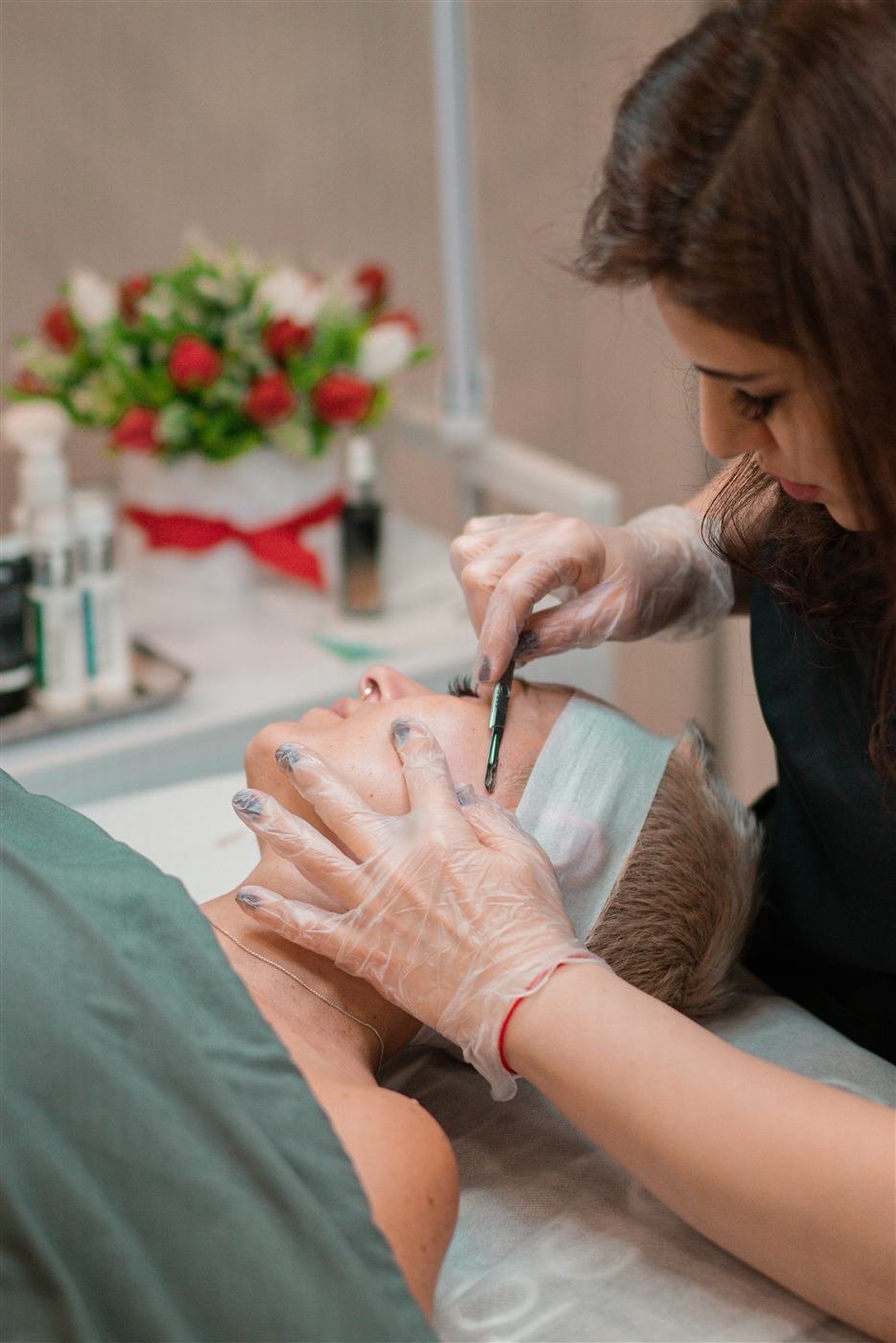
At SI Glam Glow, peach fuzz removal is carried out as a dermaplaning facial. A licensed esthetician holds a sterile, single-use blade at a shallow angle against clean, dry, taut skin and works in short controlled strokes, lifting away the fine vellus hair together with the layer of dead surface cells beneath it.
There is no wax, no thread, no heat, and no chemical. That is why it tends to suit people who have found other facial hair removal methods irritating, and why there is no recovery window to plan around afterward.
Because the exfoliation happens at the same time as the hair removal, the visible result is usually more than hair being gone — skin reflects light more evenly, and makeup has nothing fine to cling to.
Full treatment detail, pricing, package options, aftercare guidance, and real client reviews all live on the treatment page, along with the booking calendar.
See the Dermaplaning FacialOur Staten Island studio welcomes clients from across the borough, Brooklyn, and New York City seeking dermaplaning and professional facial hair removal.
Questions about the treatment itself — safety, aftercare, how often to book, combining it with other treatments — are answered on the dermaplaning facial page.
Peach fuzz is vellus hair. It is the soft, short, fine hair that covers most of the human body including the face, and it is usually pale or entirely without pigment. It exists to help regulate temperature and to make skin more responsive to touch. It is present on almost everyone from childhood onward.
It is one type of facial hair, but not the type most people mean. Peach fuzz is vellus hair: fine, soft, and pale. Terminal hair is the coarse, darker, deeply anchored hair found in the brows and lashes, and on the chin or upper lip for some people. The two look different, feel different, and respond to different removal methods, which is why advice that treats them as one thing tends to be unhelpful.
Because vellus hair is only really visible when light strikes it from an angle and scatters. A phone camera uses a wide lens held close to the face, frequently with a bright screen or flash directly in front of it, which exaggerates surface texture in a way that everyday mirror lighting does not. The hair has not changed between the two; the lighting has.
Effectively yes. Vellus hair covers most of the body on almost everybody. What varies between people is how visible it is, which depends largely on how much pigment the hair carries, the contrast against their skin tone, and the lighting they usually see themselves in, rather than on how much hair is actually there.
Laser hair removal works by emitting light that melanin absorbs. The pigment in the hair takes up that light, converts it to heat, and the heat damages the follicle. Vellus hair is pale to entirely unpigmented, so there is little or no melanin to absorb the light and the energy passes through without doing useful work at the follicle. This is the same reason blonde, red, grey, and white hair are all difficult targets for laser, and it is a property of the method rather than of any particular clinic or device.
The terms are used interchangeably, and both describe the same treatment: a dermaplaning facial. Peach fuzz removal emphasises the hair being taken away, while peach fuzz facial emphasises that it is a full facial treatment which also exfoliates the skin. Dermaplaning is simply the clinical name for the technique itself.
For fine, pale vellus hair specifically, dermaplaning is generally the better fit. Waxing and threading both remove hair from the root, which suits coarser hair but means pulling at delicate facial skin, and threading is slow across a large area like the cheeks. Dermaplaning removes the hair at the surface with no pulling and no heat, and exfoliates at the same time. For coarse, dark terminal hair, waxing or threading will serve you better.
No. How thick, how dark, and how quickly hair grows are all determined by the follicle beneath the skin, and surface removal never reaches the follicle. Hair growth is driven by genetics and hormones, neither of which is affected by anything happening at skin level.
If your facial hair is genuinely changing character rather than simply becoming more noticeable — fine pale hair turning coarse and dark, particularly if it happens quickly or is accompanied by other changes — that is a medical question and belongs with a doctor. An esthetician can remove hair; only a physician can investigate why it is changing. Wanting to remove ordinary, stable peach fuzz needs no medical justification at all.
If fine, pale peach fuzz is what you are dealing with, a dermaplaning facial is the treatment built for it. Pricing, packages, aftercare, client reviews, and the booking calendar are all on the treatment page.