
Serving clients throughout Staten Island, Brooklyn & New York City
Last Updated: September 30, 2026
If you’ve ever run your fingers over your cheeks and detected some uneven or rough areas, you’ve most likely asked yourself whether professional microdermabrasion is suitable for textured skin. The simple answer is that it is for many people, although with some exceptions. At SI Glam Glow we come across concerns about skin texture ranging from a slight dullness to persistent congestion, and microdermabrasion is one of the most direct methods of dealing with the outermost layer of the skin.
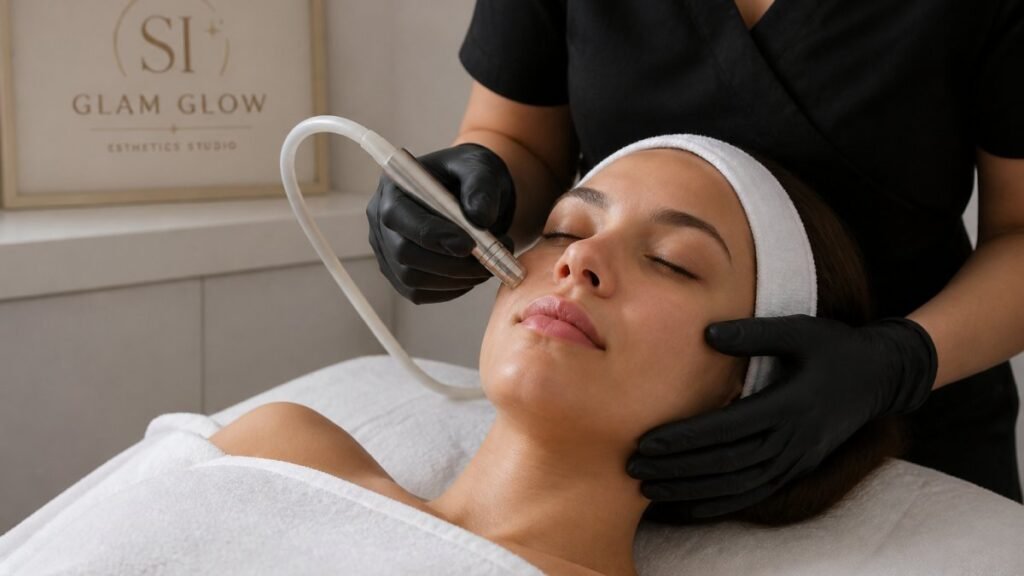
“Textured skin is a general expression and may refer to rough areas, visible pores, old acne scars, or skin that does not reflect light uniformly. Microdermabrasion acts on the outermost layer of the skin, the epidermis, by employing a wand that gently abrades the skin with fine crystals or a diamond-tipped head while at the same time using vacuum suction to remove the loose dead skin cells. This mechanical exfoliation is what the procedure relies on.”
Texture begins at the surface. If dead skin cells accumulate, they scatter light rather than reflecting it, resulting in a dull appearance. Mechanical exfoliation gets rid of that outer layer of build-up, thus exposing the cleaner skin underneath. Many clients find that their skin becomes smoother right after one treatment, although the results improve with regularity.
The vacuum’s suction also contributes by helping to remove the loosened impurities from the pores, thus reducing the appearance of clogged pores and making the pores look smaller. However, this is not a permanent alteration of your pore structure, although the visual effect can be noticeable.
Below the surface, the mild trauma caused by exfoliation causes the skin to increase the rate at which its cells are replaced. As a result of a number of treatments, collagen production is promoted, since collagen is the protein responsible for the skin’s bounce and firmness. Increased collagen over time can lead to better skin elasticity and a more uniform skin tone.
Fine lines may become less noticeable and hyperpigmentation may appear less obvious as new skin comes to the surface. Results will differ from person to person and it is consistency that is more important than any one session.
Microdermabrasion is suitable for a great many people, but it isn’t appropriate for all. The best method of finding out is to carry out a sincere evaluation of your skin type, your concerns, and any existing conditions. This is the section of the discussion that most people omit, and it is also the most important part.
People who have problems with dullness, roughness, mild acne scarring or an uneven skin tone usually achieve good results. The treatment also works well in the case of oily or congested skin, as the exfoliating and suction actions help to remove accumulated material on the surface. When your aim is to get smoother, brighter skin without any downtime, this should be considered as a viable option.
Texture concerns that tend to respond well include:
The types of texture problems that require a separate method are deep scars with pitted areas (such as ice-pick or boxcar scars), active cystic acne, and texture resulting from a underlying illness rather than from a build-up on the surface.
It is in this case that a personalized assessment is most important; in some instances you should suspend or omit microdermabrasion altogether while in other cases all we need to do is modify the method.
Skip it, or wait until the skin settles:
Proceed with caution, with adjustments:
Prior to starting any treatment, we find out about your present routine, the medications you’re on, any recent treatments you’ve had, and how your skin has reacted to exfoliation in the past. On that basis, we then decide if microdermabrasion is appropriate, if a milder treatment would be more suitable, or whether it’s better to wait a few weeks. Neither option is pushed on you, since our aim is to achieve skin that looks better and feels better, not to get you to book an appointment.
Microdermabrasion and dermaplaning are often compared when the aim is to achieve a smoother texture. Although both treatments have an exfoliating effect, they do so in a different way. With microdermabrasion, a wand operated with the aid of a vacuum is used to abrade the dead cells from the surface. Dermaplaning, on the other hand, involves the use of a sterile blade to physically scrape off the dead skin together with the fine facial hair.
| Feature | Microdermabrasion | Dermaplaning |
|---|---|---|
| Method | Vacuum wand with crystals or diamond tip | Sterile surgical blade |
| Best for | Congestion, dullness, mild scarring | Peach fuzz, surface dullness |
| Sensation | Light suction, mild abrasion | Gentle scraping |
| Downtime | Minimal | Minimal |
Knowing how to prepare for a microdermabrasion facial will make the experience more pleasant and the results better; preparation generally consists of avoiding all those things which make your skin more sensitive in the days leading up to your appointment.
A typical microdermabrasion facial lasts approximately 30 to 45 minutes, the exact time depending on the area being treated and whether it is included in a more comprehensive facial. Generally, people say that the sensation is that of a light scratching or mild suction, not pain. You might notice a slight warming as the wand is moved over your skin.
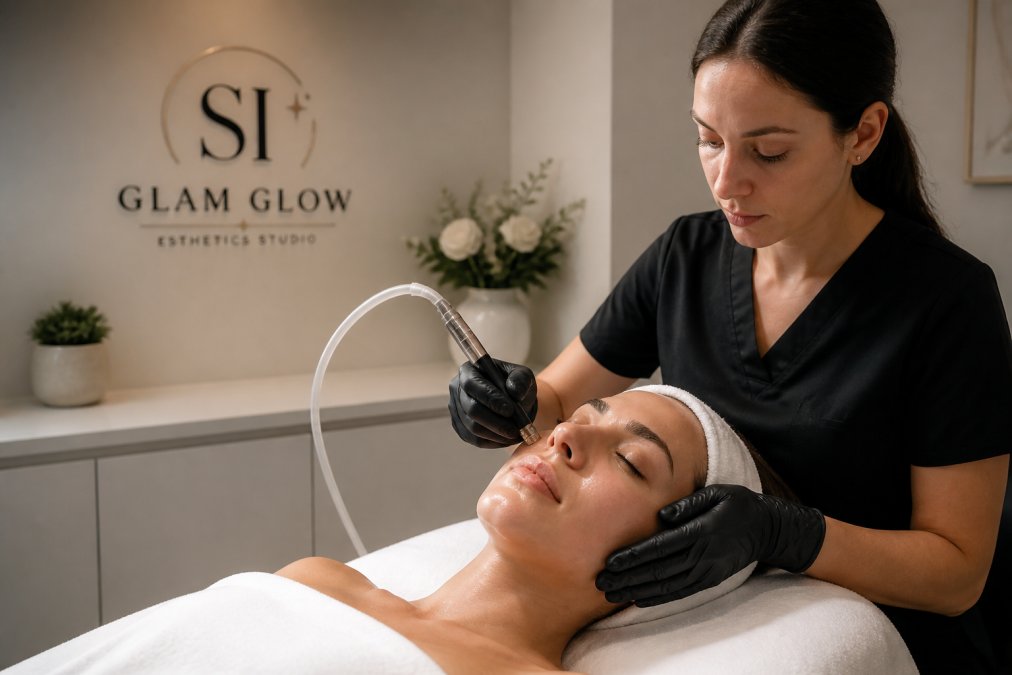
Good advice regarding aftercare for microdermabrasion should look after the new skin which you have just brought to the surface since, immediately after exfoliation, your skin barrier is more permeable and therefore should be treated gently.
The most obvious effects relate to smoothness and radiance, these typically appearing after the first treatment; improvements in tone and minor scarring generally happen after a number of sessions. How often you book is not governed by a general rule but rather depends on the type of texture in question.
A common pattern looks like this:
It is better to be consistent than intense because by spacing out your treatments your skin has a chance to recover and rebuild between them, which results in better long-term results than having your appointments too closely spaced.
In order to prevent the surface from becoming dull and to maintain an even shine, you need a treatment every four to six weeks. It is the easiest method to carry out and generally the mildest in case you fail to have one once a month.
Your schedule is not set in stone. We adjust when:
A plan is realistic if you can carry it out; even if carrying it out every three weeks doesn’t work, at least doing it every five weeks will still make some progress. The principle involved is not to have a perfect schedule, but instead to give your skin adequate time for recovery between treatments and to ensure there is enough repetition so that you can build on each result.
Book a personalized consultation at our Staten Island studio and get a skin plan built around your goals.
Book a Consultation